Request a Quote











 LAC Blog
 Export Guides
 Transport Guides
 Logistics Glossary
 Container Types & Sizes
 Incoterms 2020 Rules


TL;DR
- Step deck trailer dimensions start with a lower deck about 3.5 ft (42 in) high.
- Many step decks are built at 48 or 53 ft and have upper and lower deck sections.
- U.S. width is 102 in, and many legal loads are around 45,000 to 48,000 lb.
- A step deck is also called a single-drop or drop-deck trailer.
- Figures vary by model, so confirm the spec sheet with the carrier.
Which step deck trailer dimensions matter before booking a shipment? Deck height determines how tall the freight can be, length determines what fits, and width and weight determine whether you need permits. This guide covers the two-level design, lower and upper deck heights, typical lengths, width and weight limits, single versus double drop, loading methods, and carrier confirmation.
Step Deck Trailer Basics
Step deck trailer height involves more than the lower deck. The upper deck sits around 58 to 60 in above the road, and the step between the two decks is roughly 18 to 24 in. Manufacturers usually quote loaded height, which can differ from the empty figure once the suspension settles under cargo. Ask which figure is meant before planning tall freight.
Deck Height and Length
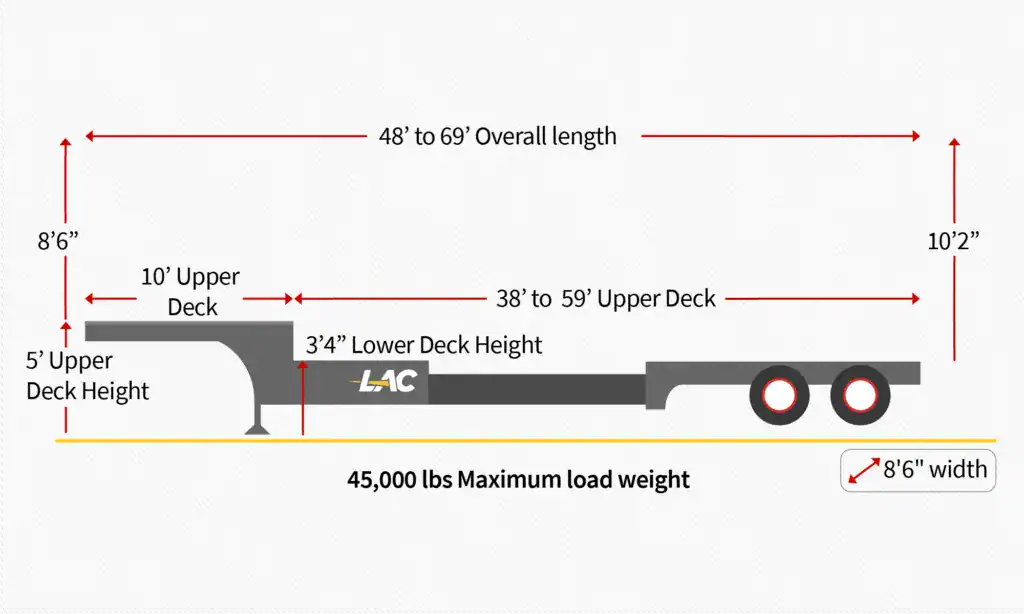
The lower deck is about 3.5 ft (42 in) high, with an industry range of about 35 to 42 in. The upper deck is often around 10 to 11 ft long, and the lower deck is often around 37 to 43 ft. Many step decks are built at 48 or 53 ft overall, which is market practice rather than a rule. Step deck trailer length therefore has two parts: the overall figure and the usable lower deck.
Step Deck Trailer Height
Step deck trailer height involves more than the lower deck. The upper deck sits around 58 to 60 in above the road, and the step between the two decks is roughly 18 to 24 in. Manufacturers usually quote loaded height, which can differ from the empty figure once the suspension settles under cargo. Ask which figure is meant before planning tall freight. How those heights translate into legal load height is covered in a separate guide.
Width and Weight Limits
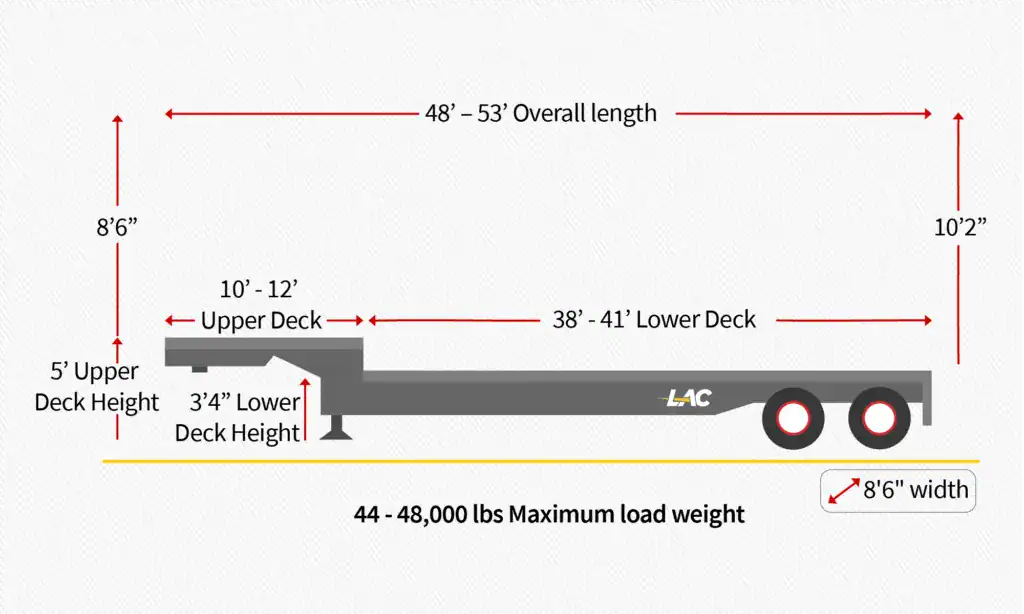
U.S. National Network width is 102 in. Wider loads may need jurisdictional permits. For comparison, a standard flatbed is also 8.5 ft wide with about 48,000 to 52,000 lb of capacity. The 80,000 lb U.S. Interstate gross reference covers tractor, trailer, and cargo, subject to axle, bridge-formula, and route rules. Many legal step deck loads land around 45,000 to 48,000 lb. Step deck trailer weight capacity is the payload remaining after you subtract the tractor and trailer tare weights.
Single Drop vs Double Drop
A step deck is also called a single drop trailer because it has one drop from the upper deck to the lower deck behind it. A double drop adds a second step. One carrier source describes a double drop as having a low center deck between the gooseneck and the rear axles, with a fixed gooseneck. Double drop trailer dimensions therefore include a well section, with deck heights usually slightly higher than an RGN (removable gooseneck).
Loading Methods Explained
The open deck supports side loading, which suits palletized freight and crated machinery handled by forklift. Equipment that drives on usually needs ramps, since the lower deck still sits well above the ground. Many shipments load from the side, from the rear or by crane. The method depends on the freight and the site, so confirm who supplies ramps or lifting equipment at pickup and delivery before the truck arrives.
When to Choose Step Deck
A step deck fits freight that is too tall for a standard flatbed but does not need a very low deck or front loading. If the load fits standard height comfortably, a flatbed is usually the simpler choice. If the load is very tall or must drive on without ramps, an RGN becomes the better answer. The decision depends on the loaded height and loading method, not the trailer name.
Freight That Fits Best
Typical step deck cargo includes:
- Construction equipment
- Farm equipment and implements
- Industrial machinery on skids or in crates
- Prefabricated building sections
- Long steel pipe and structural pieces
Lighter machines and palletized freight are common fits, since the open deck loads from the side and the lower deck adds height room. Confirm each piece against the step deck trailer dimensions of the assigned unit.
Permits and Limits
The U.S. National Network sets 102 in width, with no federal height limit; escort requirements vary by state, so confirm pilot car rules for each route. Canada’s limits are provincial or territorial, while Mexico’s 2.6 m rule applies under its federal-road standard, so plan cross-border moves accordingly. U.S. loads over 80,000 lb gross may need permits. Confirm each jurisdiction, including Mexico, on the route, since permit conditions differ.
Planning a Step Deck Move
Confirm the freight’s length, width, height, and weight as it will be loaded. Note attachments and removable parts, since lowering a boom or removing a guard can change the plan. Identify the loading method and the site access at both ends, including dock or yard space for ramps. Share photos. These details let the carrier check the freight against the step deck trailer length and lower deck height before dispatch.
Step Deck Support From LAC
LAC™ has 25+ years of experience serving commercial and B2B shippers across the Americas. LAC coordinates a network of vetted carriers, matching equipment and lane expertise to each shipment. Ground freight includes flatbed and heavy haul, with bilingual English and Spanish support for shippers working on both sides of a border.
Conclusion
Step deck trailer dimensions include a lower deck about 3.5 ft high, overall lengths commonly at 48 or 53 ft, a 102 in width, and legal loads that often land around 45,000 to 48,000 lb. Those figures vary by model and route, so confirm them with the carrier for each shipment. Measuring the freight as loaded keeps the trailer choice grounded in real numbers rather than typical figures.
FAQs
How high is a step deck lower deck?
About 3.5 ft (42 in), with an industry range of about 35 to 42 in. The figure is usually quoted as a loaded height, meaning the deck under cargo rather than the empty trailer. A lower figure within that range leaves more room for cargo height, so it is worth asking which end of the range a specific trailer sits at.
How long are step deck trailers?
Many are built at 48 or 53 ft overall. For long freight, the lower deck determines fit, so measure the longest piece and compare it with the lower deck length on the spec sheet. Measure it as loaded, including packaging and overhangs. If a piece is close to the lower deck length, confirm the exact measurement with the carrier before booking rather than relying on estimates.
What weight can a step deck carry?
Many legal loads land around 45,000 to 48,000 lb. The exact figure depends on the tractor, the trailer’s own weight, the axle configuration, and the route, since the 80,000 lb gross limit covers everything on the road together. Heavier freight may need additional axles or a permit, which the carrier confirms for the specific lane. Sharing an accurate freight weight early, including crating, lets the carrier check payload before dispatch.
What is a double drop trailer?
One carrier source describes a double drop as a trailer with a low center deck and a fixed gooseneck. Because the gooseneck stays attached, freight cannot load over the front, so the loading method needs the same planning as a step deck. Only the center section sits low, so ask the carrier for the usable length of that center deck on the unit before matching tall pieces to the trailer.
Can a step deck carry oversize loads?
Yes, with permits when you exceed limits. The practical step is sharing the widest and heaviest figures as loaded, not the dimensions of the machine at rest, since attachments and packaging can push a load over a limit. Rules vary by state, province, or Mexican authority, so check the route jurisdiction by jurisdiction, and confirm the permit plan with the carrier before booking the move.
How do I confirm dimensions with a carrier?
Ask for the spec sheet of the specific trailer assigned, not a generic model page, and request the loaded deck height in writing. Confirm the usable lower deck length and the axle configuration at the same time. A written confirmation reduces the chance of a mismatch on pickup day if a different unit arrives. If the unit changes, ask for the new spec sheet and loaded deck height before pickup.