Request a Quote










 LAC Blog
 Export Guides
 Transport Guides
 Logistics Glossary
 Container Types & Sizes
 Incoterms 2020 Rules


TL;DR
- Step deck max height depends on the route limit minus the loaded deck height.
- Most US states set limits between 13 ft 6 in and 14 ft.
- A 42 in deck under a 13 ft 6 in limit leaves about 10 ft of cargo.
- Canadian provinces set limits separately; Mexico’s federal-road limit is 4.25 m.
- Permits, escorts, and clearances vary by state or province, so plan to the strictest limit.
What is the step deck max height for a tall load? It is not a single number. The answer depends on each jurisdiction’s height limit along the route and how high the deck sits once loaded. This guide covers who sets height limits, how a step deck adds clearance, a worked calculation, permit triggers, regional variations, and planning.
Legal Height Limits Overview
The United States has no federal vehicle height limit. Each state sets its own, and most fall between 13 ft 6 in and 14 ft. Height is measured from the road surface to the top of the load, so deck, dunnage, and cargo all count. The step deck height limit on a lane is the strictest state figure along the route, and step deck legal load height is what remains after you subtract the deck.
How Step Decks Add Clearance
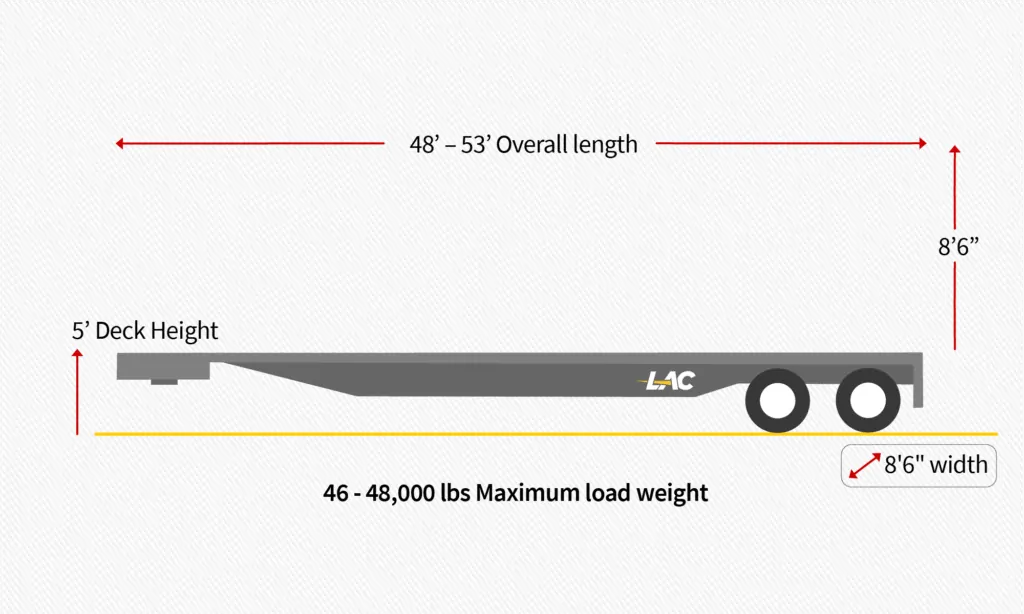
A standard flatbed deck sits about 58 to 60 in above the road. A step deck lower deck is about 3.5 ft (42 in). That difference, about 16 to 18 in, becomes usable load height. Step deck legal load height is higher than flatbed legal load height on the same route for exactly this reason: the cargo starts closer to the ground, so more of the limit is left for the freight itself.
Load Height Calculation Example
Take a state with a 13 ft 6 in limit, which is 162 in. Subtract a 42 in lower deck and 120 in remain, for about 10 ft of step-deck load height. On a 36 in deck in the same state, the cargo can reach about 10 ft 6 in. The arithmetic is simple, but it is a calculation from a state limit, not a permit exemption, and it changes the moment the route crosses into a stricter jurisdiction.
Standard Height Thresholds
The commonly cited oversize reference points are:
- Over about 13.5 ft tall
- Over about 8.5 ft wide
- Over about 80,000 lb gross vehicle weight
These figures vary by state or province; most state height limits are between 13.5 ft and 14 ft, and 13.5 ft is a reference, not a federal rule. The oversize load height limit on a particular lane may sit higher or lower, so the thresholds are a starting point for planning rather than the final answer.
When Permits Become Necessary
A permit, often called an over-dimensional permit, is needed when the load exceeds a route limit for height, width, or weight. Oversize loads may also need banners, flags, night lighting, and escort vehicles depending on the jurisdiction. The first step in any permit process is accurate information: dimensions as hauled, axle and gross weights, and the planned route. Those details let the carrier and the issuing authority confirm what applies.
Route and State Variations
Limits change at state lines and at the border. A 14 ft load can be legal in one state at 14.5 ft and need a permit next door at 13.5 ft.
- Most US states: 13 ft 6 in to 14 ft, state by state
- Canada: provincial or territorial; check each province (example: 4.15 m)
- Mexico: 4.25 m federal roads; confirm local limits
Plan to the lowest limit on the lane.
Escort and Pilot Car Notes
A pilot car is commonly required for loads over about 12 ft wide, depending on the state. Tall loads can also trigger escort requirements, depending on the jurisdiction. Escort requirements are state law, and no federal escort standard exists, so a lane crossing several states may need different escort arrangements along the way. Confirm the rules with the carrier and the issuing authority for each segment of the route before dispatching the truck.
Tall Freight Planning Steps
Three planning steps:
- Measure the freight as it will be hauled, including anything that adds height
- Confirm the loaded deck height of the specific trailer
- Check the strictest height limit on the route, state by state and province by province
One more check overrides all of them. A low posted bridge clearance on the route overrides the state limit, so the route survey matters as much as the arithmetic.
Other Trailers for Tall Loads
When the step deck max height still falls short, a lower deck is the next option. An RGN (removable gooseneck) deck is about 18 to 24 in, which can add well over a foot of load height compared with a step deck. One carrier source describes a double drop as having a low center deck for the tallest section of a load. At the other end, a flatbed suits freight that sits comfortably within standard height.
Working With a Specialist
As a freight forwarder, LAC does not own or operate trailers. LAC coordinates a network of vetted carriers, matching the right equipment and lane expertise to each shipment, including the deck height the load needs. The most useful thing a shipper can do is share dimensions and the route early, before dates are fixed, so permits and equipment can be lined up in the right order.
Height Planning Support From LAC
LAC™ has 25+ years of experience serving commercial and B2B shippers across the Americas. LAC coordinates a network of vetted carriers and cross-border freight within the United States-Mexico-Canada Agreement (USMCA) region, so LAC reviews the height limits of every jurisdiction on a lane before assigning equipment. Bilingual English and Spanish support means shippers and receivers on either side of a border can work from the same measurements.
Conclusion
Step deck max height depends on two numbers: the loaded deck height and the strictest height limit on the route. Subtract one from the other, and the result is the legal cargo height for that lane. Limits vary by jurisdiction, and a posted bridge clearance can override them, so measure as hauled and plan to the lowest figure. A lower deck raises that result, and a stricter jurisdiction lowers it.
FAQs
What is the maximum load height on a step deck?
About 10 ft of cargo on a 42 in lower deck under a 13 ft 6 in limit. The figure rises on a lower deck or in a state with a 14 ft limit, and falls on a stricter route. There is no single maximum, only the result for a specific trailer on a specific lane. Before relying on 10 ft, confirm the loaded deck height of the assigned trailer and the lowest limit on the route.
Does load height include the deck?
Yes. Height is measured from the road surface to the top of the load, so the deck, any blocking or dunnage under the freight, and the cargo itself all count toward the limit. This is why the loaded deck height matters so much: every inch the deck takes is an inch the cargo cannot use. Measure the freight as hauled, then add the deck and any blocking before comparing the total with the route limit.
When does a tall load need a permit?
When it exceeds a height limit on the route, commonly cited at about 13.5 ft but set by each state or province. A load can be legal for most of a trip and still need a permit for one segment. The permit is tied to the route, so changing the route can change the answer. Share the full route early so you can identify any permit-required segments before dispatch.
Do limits differ by state or province?
Yes. Most US states set limits between 13 ft 6 in and 14 ft, while Canadian provinces and territories set limits (4.15 m, for example), and Mexico’s federal roads use 4.25 m (13 ft 11 in). A cross-border lane is planned to the lowest limit it passes through, not the limit at origin or destination. One strict segment can set the plan for the whole trip, so confirm each state or province crossed before booking.
Is an RGN better for very tall loads?
Often, because an RGN deck sits about 18 to 24 in above the road, well below a step deck lower deck. That extra clearance can bring a tall machine within the route limit without a permit. It depends on the freight, since the RGN loads from the front and suits drivable equipment. Confirm the fit with the carrier, and share whether the machine runs, since that decides if front loading works.
What details are needed to check height?
Three items: the height of the freight as hauled, the loaded deck height of the trailer assigned, and the full route including every state or province crossed. Add any known low clearances near pickup or delivery. With these, a carrier can confirm whether the load runs legal or needs a permit. Photos showing the highest point of the freight also help the carrier confirm the measurement before assigning the trailer.