
 Request a Quote











 LAC Blog
 Export Guides
 Transport Guides
 Logistics Glossary
 Container Types & Sizes
 Incoterms 2020 Rules


Is Canada really starting to move away from the United States, or is it simply discovering the cost of depending too heavily on a single trading partner?
Trade tensions between the two countries persist. At the same time, Canada has been making a series of moves that would have attracted far more attention just a few years ago.
From deeper engagement with Europe to renewed commercial openings with China and new export diversification initiatives, Canada appears to be building more options beyond the U.S. market.
The question is not whether Canada wants to diversify.
The more important question is how far that diversification can realistically go.
Canada Is Expanding Its Options
One of the clearest signs of this shift is Canada’s growing engagement with Europe.
Canada has already become the first non-European country to participate in SAFE, the European Union’s defense procurement instrument. There is also growing discussion around the possibility of creating an “associate member” status for Canada within the European Union, although what that classification would actually mean remains unclear.
The significance may therefore be less about the formal structure and more about the direction of travel.
Canada is actively looking for ways to deepen economic and strategic relationships beyond North America.
A similar pattern can be seen elsewhere.
Canada has begun reopening the door to Chinese electric vehicles and has also created a Strategic Exports Office with a clear objective: helping Canadian companies compete internationally and diversify their export markets.
Individually, these developments may appear unrelated.
Together, they suggest that Canada is trying to create more options and reduce its significant dependence on the U.S. market.
The U.S. Relationship Is Still Dominant
That dependence remains substantial.
In 2025, 71.7% of Canadian merchandise exports still went to the United States.
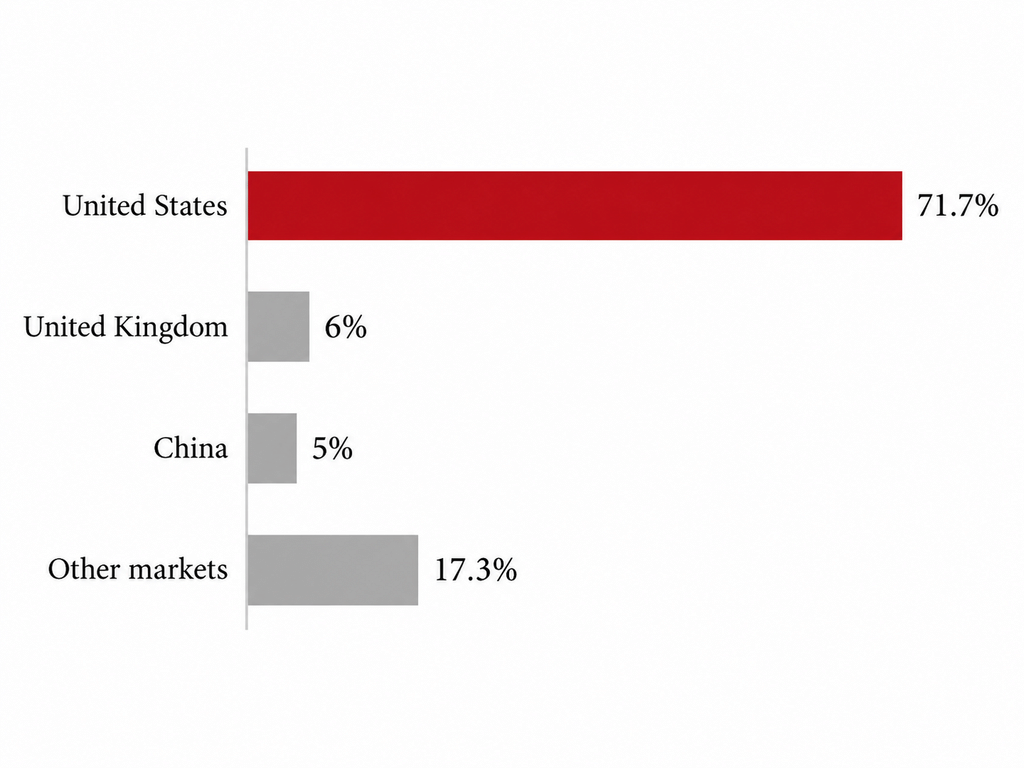
That figure helps explain why Canada’s outreach to Europe, Asia, and other markets should be viewed more as a diversification strategy than as a realistic alternative to its relationship with the U.S.
The scale of the existing relationship matters.
Canada and the United States share one of the longest borders in the world and decades of deeply integrated production networks. Automotive and auto parts, energy, agriculture, manufacturing, and many other sectors do not operate simply as trade between two separate economies.
In many cases, they function as integrated North American supply chains.
For businesses involved in freight, transportation, and logistics, that distinction is especially important.
The relationship is not built only on trade agreements or political alignment. It is also supported by physical infrastructure, supplier networks, transportation corridors, distribution centers, cross-border labor relationships, and decades of operational integration.
Those systems are difficult to replicate elsewhere.
Diversification Is Not the Same as Decoupling
This is where the current situation becomes more interesting.
Canada may want more commercial flexibility, but expanding into other markets does not necessarily mean reducing the importance of the U.S. relationship in absolute terms.
Europe can become more important.
China can regain some space.
Canada can develop new export opportunities in energy, minerals, agriculture, manufacturing, and other sectors.
Diversification and decoupling are very different strategies.
But diversification and decoupling are very different strategies.
Canada can reduce concentration risk while still maintaining the United States as its dominant trading partner.
In fact, from a logistics perspective, that may be the most realistic outcome.
Geography remains a powerful competitive advantage.
Shorter transit distances, extensive road and rail networks, integrated industrial regions, and established border infrastructure all reinforce the natural flow of goods between the two countries.
Trade policy can influence those flows, but it cannot erase those structural advantages.
Domestic Politics Add Another Layer of Complexity
Canada is pursuing this broader international strategy at a time when it is also facing important political discussions at home.
Quebec will hold elections on October 5, with the sovereignty question once again part of the political conversation. Alberta will hold a referendum on October 19 that includes a question related to a potential process toward separation.
These developments do not necessarily determine Canada’s trade strategy, but they add another layer of uncertainty.
Canada is attempting to strengthen its international position while also managing internal debates about federalism, regional priorities, and economic policy.
That makes the current period particularly important.
The country is not only rethinking where it trades. It is also navigating how different regions within Canada view their own economic interests and their relationship with the federal government.
Washington Is Also Reassessing the Western Hemisphere
At the same time, Washington appears to be placing renewed strategic attention on the Western Hemisphere.
Recent developments involving Venezuelan oil, Greenland, and U.S. efforts to strengthen economic ties with countries across Latin America fit into a broader picture in which trade, energy, critical minerals, security, and supply chains are becoming increasingly connected to geopolitics.
These developments should not necessarily be interpreted as part of a single coordinated strategy.
However, they do suggest that the Western Hemisphere is becoming more strategically relevant to the United States.
For Canada, that creates an interesting tension.
While Ottawa is trying to broaden its commercial relationships, Washington is increasing its focus on the same broader regional environment in which Canada operates.
Geography Still Matters
Perhaps that is why the familiar analogy between Canada and the United States continues to work.
They are often described as two siblings.
They may argue. They may create distance. They may build stronger relationships elsewhere.
But they still live next door to each other.
From a trade and logistics perspective, that matters enormously.
Supply chains are shaped not only by politics but also by distance, infrastructure, cost, transit time, reliability, and existing commercial relationships.
Canada can redirect a greater share of its trade toward Europe, Asia, and other regions. It can build new export corridors and reduce its exposure to any single market.
But the economic logic of trading with the United States will remain difficult to replace.
What This Means for Trade and Logistics
For the logistics industry, Canada’s diversification strategy is worth watching closely.
If Canadian exporters continue to expand into new markets, that could gradually create demand for different transportation patterns, new ocean routes, additional port capacity, more warehousing, and new freight forwarding opportunities.
The impact is unlikely to be immediate.
It is more likely to be cumulative.
Small shifts in sourcing, export destinations, industrial investment, and trade policy can eventually reshape cargo flows in meaningful ways.
That is why the most important issue may not be whether Canada is moving away from the United States.
It may be whether Canada can build enough commercial alternatives to become less vulnerable to future political and trade disruptions while preserving the advantages of one of the world’s most integrated bilateral economic relationships.
We may be witnessing the beginning of a more balanced and diversified trade structure.
Or, a few years from now, this period may simply look like another difficult chapter between two economies that remain too integrated to truly separate.
In the long run, what will matter more: the political will to diversify, or the force of geography, infrastructure, and supply chains built over decades?